Mostrando postagens com marcador Edgar Allan Poe. Mostrar todas as postagens

Soneto à Ciência


Ciência! Do velho Tempo és filha predileta!
Tudo alteras, com o olhar que tudo inquire e invade!
Por que rasgas assim o coração do poeta,
abutre, que asas tens de triste Realidade?

Poderia êle amar-te, achar sabedoria
em ti, se ousas cortar seu vôo errante e ao léu
quando tenta extrair os tesouros do céu,
mesmo que a asa se eleve indômita e bravia?

Não furtaste a Diana o carro? E não forçaste
a Hamadríade do bosque a procurar, fugindo,
estrêla mais feliz, que para sempre a esconda?

Não arrancaste à Ninfa as carícias da onda,
e ao Elfo a verde relva? E a mim, não me roubaste
o sonho de verão ao pé do tamarindo?


Em inglês:


SONNET — TO SCIENCE


Science! true daughter of Old Time thou art!
Who alterest all things with thy peering eyes.
Why preyest thou thus upon the poet's heart,
Vulture, whose wings are dull realities?

How should he love thee? or how deem thee wise,
Who wouldst not leave him in his wandering
To seek for treasure in the jewelled skies,
Albeit he soared with an undaunted wing?

Hast thou not dragged Diana from her car?
And driven the Hamadryad from the wood
To seek a shelter in some happier star?

Hast thou not torn the Naiad from her flood,
The Elfin from the green grass, and from me
The summer dream beneath the tamarind tree?


Edgar Allan Poe - 'Ficção completa, poesias & ensaios". [organização, tradução e anotações Oscar Mendes com a colaboração Milton Amado]. Rio de Janeiro: Companhia Aguilar Editora, 1965. (grafia original 1965).

Sonhos


FÔSSE-ME a infância um sonho prolongado!
Nem a alma despertasse, até que o brilho
da manhã viesse numa Eternidade!
Mesmo que o longo sonho fôsse triste,
desesperado, bem melhor seria
que o despertar da fria realidade,
para quem, no seu peito, só tem tido
e tem, na terra deliciosa, um caos 
de paixões fundas, desde o nascimento.
Mas seria – êsse sonho eternamente
continuado – tal como os outros eram,
na minha infância e, se me fôsse dado,
só um louco aspiraria a céu mais alto.
Tivesse eu mergulhado, à luz do sol,
num céu de estio, em sonhos de luz viva,
e de prazer, voasse o coração
a regiões imaginárias, longe
de meu lar, entre sêres só pensados
por mim – que mais eu quereria ver?
Uma vez. . . uma só – e essa hora estranha
jamais esquecerei – certo feitiço
ou poder me empolgou; o frio vento
fustigou-me, na noite, e deixou na alma
sua impressao. . . e, ou foi a lua cheia
brilhando, das alturas, no meu sono,
tão fria . . ou as estrêlas. . . ou o que fôsse,
tal sonho foi apenas como o vento
dessa noite... deixemo-lo passar.
Tenho sido feliz, embora em sonhos.
Tenho sido feliz, e amo dizê-lo.
Sonhos! Na sua forte côr de vida,
como nesse rumor sombrio, nevoento,
que imita a realidade, trazem, para
o delirante olhar, mais belas coisas
de Paraíso e Amor – e minhas, todas! –
do que já pôde a jovem Esperança
conhecer em suas horas de mais luz.


DREAMS.

OH! that my young life were a lasting dream!
My spirit not awakening, till the beam
Of an Eternity should bring the morrow.
Yes! tho' that long dream were of hopeless sorrow,
'Twere better than the cold reality
Of waking life, to him whose heart must be,
And hath been still, upon the lovely earth,
A chaos of deep passion, from his birth.

But should it be – that dream eternally
Continuing – as dreams have been to me
In my young boyhood – should it thus be given,
'Twere folly still to hope for higher Heaven.
For I have revell'd, when the sun was bright
I' the summer sky, in dreams of living light,
And loveliness, – have left my very heart
In climes of my imagining, apart
From mine own home, with beings that have been
Of mine own thought – what more could I have seen?

'Twas once – and only once – and the wild hour
From my remembrance shall not pass – some power
Or spell had bound me – 'twas the chilly wind
Came o'er me in the night, and left behind
Its image on my spirit – or the moon
Shone on my slumbers in her lofty noon
Too coldly – or the stars – howe'er it was
That dream was as that night-wind – let it pass.

I have been happy, tho' [but] in a dream.
I have been happy – and I love the theme:
Dreams! in their vivid coloring of life
As in that fleeting, shadowy, misty strife
Of semblance with reality which brings
To the delirious eye, more lovely things
Of Paradise and Love – and all our own!

Than young Hope in his sunniest hour hath known.

Edgar Allan Poe - 'Ficção completa, poesias & ensaios". [organização, tradução e anotações Oscar Mendes e Milton Amado]. Rio de Janeiro: Companhia Aguilar Editora, 1965. (grafia original 1965).

Um Sonho


SONHEI, entre visões da noite escura,
com a alegria morta, mas meu sonho
de vida e luz me despertou, tristonho,
com o coração partido de amargura.

Ah! que não vale um sonho à luz do dia
para aquêle que os olhos traz cravados
nas coisas que o rodeiam e os desvia
para tempos passados?

Aquêle santo sonho, sonho santo,
enquanto o mundo repelia o pária,
deu-me o confôrto, como luz de encanto
a conduzir uma alma solitária.

E embora a luz, por entre a tempestade
e a noite, assim tremesse, tão distante,
que poderia haver de mais brilhante
no claro sol da estrêla da Verdade?


A DREAM


In visions of the dark night
I have dreamed of joy departed —
But a waking dream of life and light
Hath left me broken-hearted.

Ah! what is not a dream by day
To him whose eyes are cast
On things around him with a ray
Turned back upon the past?

That holy dream — that holy dream,
While all the world were chiding,
Hath cheered me as a lovely beam
A lonely spirit guiding.

What though that light, thro' storm and night,
So trembled from afar —
What could there be more purely bright
In Truth's day-star?


Edgar Allan Poe - 'Ficção completa, poesias & ensaios". [organização, tradução e anotações Oscar Mendes e Milton Amado]. Rio de Janeiro: Companhia Aguilar Editora, 1965. (grafia original 1965).

Annabel Lee


HÁ MUITOS, muitos anos, existia
num reino à beira-mar, em que vivi,
uma donzela, de alta fidalguia,
chamada ANNABEL LEE.
Amava-me, e o seu sonho consistia
em ter-me sempre para si.

Eu era criança, ela era uma criança
no reino à beira-mar, em que vivi.
Mas tanto o nosso amor ultrapassava
o próprio amor, que até senti
os serafins celestes invejarem
a mim e a ANNABEL LEE.

Por isso mesmo, há muitos, muitos anos,
no reino à beira-mar, em que vivi,
gélido, de uma nuvem, veio um vento
matar ANNABEL LEE.
E seus nobres parentes se apressaram
em tirá-la de mim: encerrarem-na vi
num sepulcro bem junto ao mar, que chora
eternamente ali.

Foi inveja dos anjos: mais felizes
éramos nós aqui.
Sim, foi por isso (como todos sabem
no reino à beira-mar, em que a perdi)
que veio um vento, à noite, de uma nuvem
matar ANNABEL LEE.

Mas nosso amor, imenso, era mais forte
do que o tempo e que a morte,
do que a própria esperança em que o envolvi.
E nem anjos celestes nas alturas,
nem demónios dos mares abissais
jamais minha alma afastarão, jamais,
da bela ANNABEL LEE.

Pois, quando surge a lua, em meus sonhos flutua,
no luar, ANNABEL LEE.
E, quando se ergue a estrêla, o seu fulgor revela
o olhar de ANNABEL LEE.
E junto a ela eu passo, assim, a noite inteira,
junto àquela que adoro, a espôsa, a companheira,
na tumba, à beira-mar, do reino em que vivi,
junto ao mar que por ti
soluça eternamente, ANNABEL LEE.


ANNABEL LEE

It was many and many a year ago,
In a kingdom by the sea,
That a maiden there lived whom you may know
By the name of ANNABEL LEE; –
And this maiden she lived with no other thought
Than to love and be loved by me.

I was a child and she was a child,
In this kingdom by the sea,
But we loved with a love that was more than love –
I and my ANNABEL LEE –
With a love that the wingéd seraphs of Heaven
Coveted her and me.

And this was the reason that, long ago,
In this kingdom by the sea,
A wind blew out of a cloud by night
Chilling my ANNABEL LEE;
So that her high-born kinsman came
And bore her away from me,
To shut her up in a sepulchre
In this kingdom by the sea.

The angels, not half so happy in Heaven,
Went envying her and me;
Yes! that was the reason (as all men know,
In this kingdom by the sea)
That the wind came out of the cloud, chilling
And killing my ANNABEL LEE.

But our love it was stronger by far than the love
Of those who were older than we –
Of many far wiser than we –
And neither the angels in Heaven above
Nor the demons down under the sea
Can ever dissever my soul from the soul
Of the beautiful ANNABEL LEE: –

For the moon never beams without bringing me dreams
Of the beautiful ANNABEL LEE;
And the stars never rise but I see the bright eyes
Of the beautiful ANNABEL LEE;
And so, all the night-tide, I lie down by the side
Of my darling, my darling, my life and my bride
In the sepulchre there by the sea –
In her tomb by the side of the sea.


1849.
Edgar Allan Poe - 'Ficção completa, poesias & ensaios". [organização, tradução e anotações Oscar Mendes e Milton Amado]. Rio de Janeiro: Companhia Aguilar Editora, 1965. (grafia original 1965).

The Raven


Once upon a midnight dreary, while I pondered, weak and weary,
Over many a quaint and curious volume of forgotten lore,
While I nodded, nearly napping, suddenly there came a tapping,
As of some one gently rapping, rapping at my chamber door.
"'Tis some visitor," I muttered, "tapping at my chamber door-
Only this, and nothing more."

Ah, distinctly I remember it was in the bleak December,
And each separate dying ember wrought its ghost upon the floor.
Eagerly I wished the morrow;- vainly I had sought to borrow
From my books surcease of sorrow- sorrow for the lost Lenore-
For the rare and radiant maiden whom the angels name Lenore-
Nameless here for evermore.

And the silken sad uncertain rustling of each purple curtain
Thrilled me- filled me with fantastic terrors never felt before;
So that now, to still the beating of my heart, I stood repeating,
"'Tis some visitor entreating entrance at my chamber door-
Some late visitor entreating entrance at my chamber door;-
This it is, and nothing more."

Presently my soul grew stronger; hesitating then no longer,
"Sir," said I, "or Madam, truly your forgiveness I implore;
But the fact is I was napping, and so gently you came rapping,
And so faintly you came tapping, tapping at my chamber door,
That I scarce was sure I heard you"- here I opened wide the door;-
Darkness there, and nothing more.

Deep into that darkness peering, long I stood there wondering, fearing,
Doubting, dreaming dreams no mortals ever dared to dream before;
But the silence was unbroken, and the stillness gave no token,
And the only word there spoken was the whispered word, "Lenore!"
This I whispered, and an echo murmured back the word, "Lenore!"-
Merely this, and nothing more.

Back into the chamber turning, all my soul within me burning,
Soon again I heard a tapping somewhat louder than before.
"Surely," said I, "surely that is something at my window lattice:
Let me see, then, what thereat is, and this mystery explore-
Let my heart be still a moment and this mystery explore;-
'Tis the wind and nothing more."

Open here I flung the shutter, when, with many a flirt and flutter,
In there stepped a stately raven of the saintly days of yore;
Not the least obeisance made he; not a minute stopped or stayed he;
But, with mien of lord or lady, perched above my chamber door-
Perched upon a bust of Pallas just above my chamber door-
Perched, and sat, and nothing more.

Then this ebony bird beguiling my sad fancy into smiling,
By the grave and stern decorum of the countenance it wore.
"Though thy crest be shorn and shaven, thou," I said, "art sure no craven,
Ghastly grim and ancient raven wandering from the Nightly shore-
Tell me what thy lordly name is on the Night's Plutonian shore!"
Quoth the Raven, "Nevermore."

Much I marvelled this ungainly fowl to hear discourse so plainly,
Though its answer little meaning- little relevancy bore;
For we cannot help agreeing that no living human being
Ever yet was blest with seeing bird above his chamber door-
Bird or beast upon the sculptured bust above his chamber door,
With such name as "Nevermore."

But the raven, sitting lonely on the placid bust, spoke only
That one word, as if his soul in that one word he did outpour.
Nothing further then he uttered- not a feather then he fluttered-
Till I scarcely more than muttered, "other friends have flown before-
On the morrow he will leave me, as my hopes have flown before."
Then the bird said, "Nevermore."

Startled at the stillness broken by reply so aptly spoken,
"Doubtless," said I, "what it utters is its only stock and store,
Caught from some unhappy master whom unmerciful Disaster
Followed fast and followed faster till his songs one burden bore-
Till the dirges of his Hope that melancholy burden bore
Of 'Never- nevermore'."

But the Raven still beguiling all my fancy into smiling,
Straight I wheeled a cushioned seat in front of bird, and bust and
door; Then upon the velvet sinking, I betook myself to linking
Fancy unto fancy, thinking what this ominous bird of yore-
What this grim, ungainly, ghastly, gaunt and ominous bird of yore
Meant in croaking "Nevermore."

This I sat engaged in guessing, but no syllable expressing
To the fowl whose fiery eyes now burned into my bosom's core;
This and more I sat divining, with my head at ease reclining
On the cushion's velvet lining that the lamplight gloated o'er,
But whose velvet violet lining with the lamplight gloating o'er,
She shall press, ah, nevermore!

Then methought the air grew denser, perfumed from an unseen censer
Swung by Seraphim whose footfalls tinkled on the tufted floor.
"Wretch," I cried, "thy God hath lent thee- by these angels he hath sent thee
Respite- respite and nepenthe, from thy memories of Lenore!
Quaff, oh quaff this kind nepenthe and forget this lost Lenore!"

Quoth the Raven, "Nevermore."

"Prophet!" said I, "thing of evil!- prophet still, if bird or devil!-
Whether Tempter sent, or whether tempest tossed thee here ashore,
Desolate yet all undaunted, on this desert land enchanted-
On this home by horror haunted- tell me truly, I implore-
Is there- is there balm in Gilead?- tell me- tell me, I implore!"
Quoth the Raven, "Nevermore."

"Prophet!" said I, "thing of evil- prophet still, if bird or devil!
By that Heaven that bends above us- by that God we both adore-
Tell this soul with sorrow laden if, within the distant Aidenn,
It shall clasp a sainted maiden whom the angels name Lenore -
Clasp a rare and radiant maiden whom the angels name Lenore."
Quoth the Raven, "Nevermore."

"By that word our sign of parting, bird or fiend!" I shrieked, upstarting -
"Get thee back into the tempest and the Night's Plutonian shore!
Leave no black plume as a token of that lie thy soul hath spoken!
Leave my loneliness unbroken!- quit the bust above my door!
Take thy beak from out my heart, and take thy form from off my door!"
Quoth the Raven, "Nevermore."

And the Raven, never flitting, still is sitting, still is sitting
On the pallid bust of Pallas just above my chamber door;
And his eyes have all the seeming of a demon's that is dreaming,
And the lamplight o'er him streaming throws his shadow on the floor;
And my soul from out that shadow that lies floating on the floor
Shall be lifted- nevermore!


Edgar Allan Poe

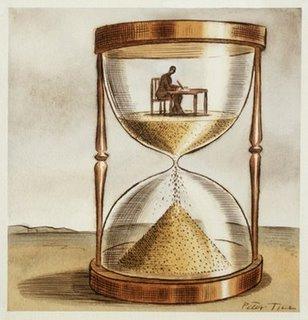
O Tempo seca o Amor

O tempo seca a beleza, seca o amor, seca as palavras. Deixa tudo solto, leve, desunido para sempre como as areias nas águas. O tempo seca a ...

Nos últimos 30 dias.